
Every article should show its work
Most AI writing demos stop one screen too soon.
They begin with a prompt. A few seconds pass. An article appears. Then the demo ends, as if the appearance of words settled the question.
It did not.
The useful questions begin after the draft exists:
- What sources did it use?
- Which checks actually ran?
- What could not be fixed?
- Whose name will appear on it?
If a system cannot answer those questions, it has not handed you an article. It has handed you a block of text and made the rest your problem.
That is why every Mastheads article shows its work.
The source list should be part of the article record
An article can sound certain and still be wrong. Smooth writing tells you very little about where a claim came from.
Mastheads searches first. Its nine editorial desks work from the sources they find, and the article keeps that source list beside it. You can open the record and see what the desks had in front of them.
That does not make every source perfect. It makes the evidence visible. An editor can question a weak source, follow a citation, or decide that the article needs more reporting before publication. Those are normal editorial decisions. Hiding the source list only makes them harder.
A check should leave a record
"Fact-checked" is easy to type into a badge. The better question is: what was checked?
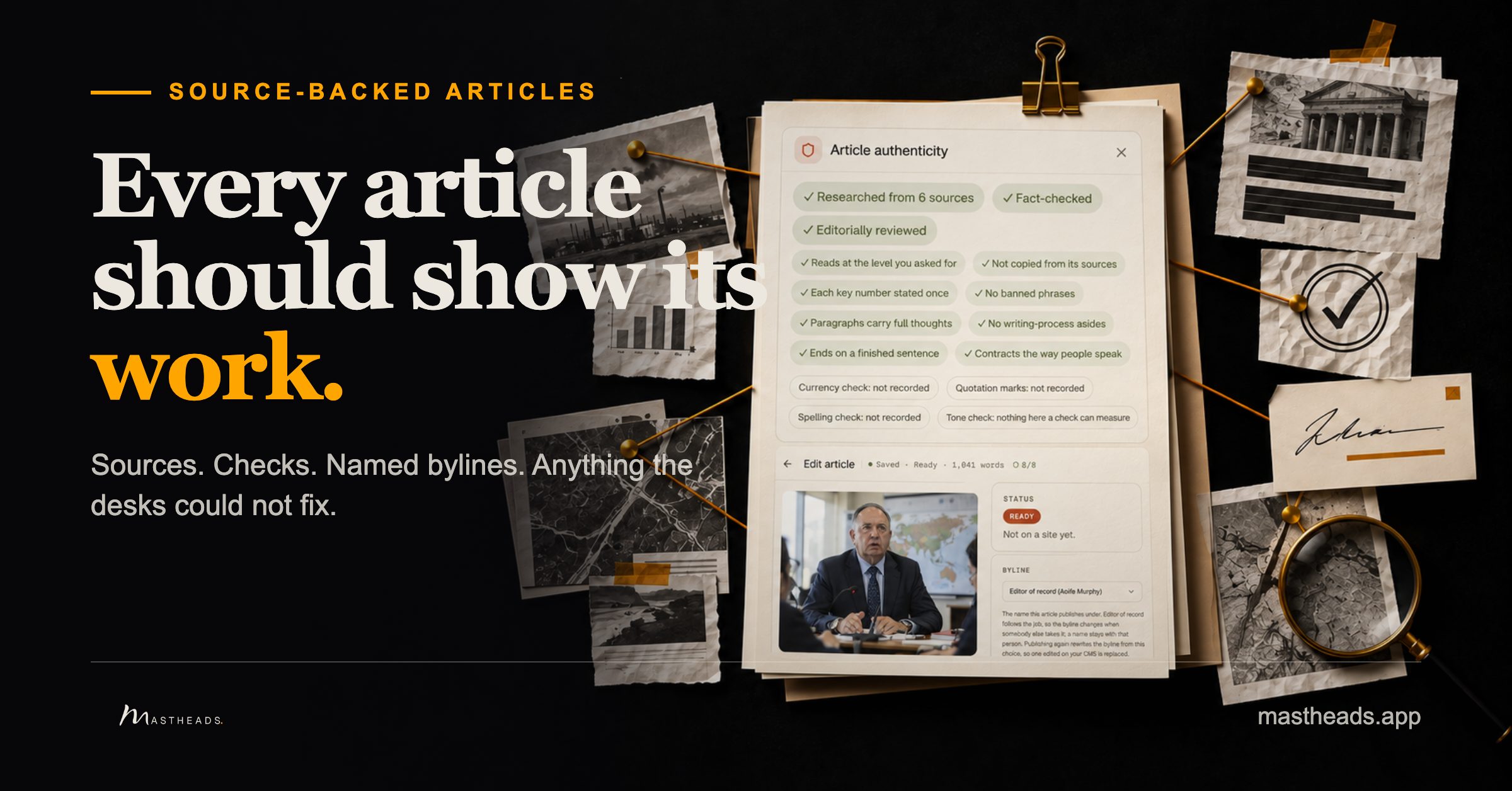
The Article authenticity panel answers in plain words. It records the checks that passed, such as whether the article was fact-checked, whether key numbers were stated once, and whether paragraphs carry complete thoughts. It also names checks that were not recorded or did not apply.
That distinction matters. A green wall of vague promises is not evidence. A record of what ran, what passed, and what was not measured gives an editor something they can inspect.
The same rule applies when the desks fall short. If the sources do not support the requested topic, Mastheads refuses before writing the article. If a written article contains a fabricated quotation or no supported figure at all, it is refused delivery. Other problems that remain are shown with the article instead of being quietly hidden.
Good editorial software should not pretend every run went perfectly. It should tell you what happened while there is still time to act.
A byline is a responsibility, not decoration
The last question is the most human one: whose name is on it?
Mastheads gives a publication named authors and an editor of record. The selected name reaches the published article as a real byline.
That choice changes the standard. When a real person or publication will be named, "good enough for AI" is no longer good enough. The draft needs sources worth defending, checks worth inspecting, and a clear path back to the decisions that produced it.
The byline does not make the system trustworthy by itself. It makes responsibility visible. The article record gives that responsibility something solid to stand on.
Do not reduce trust to a score
A score out of 100 looks neat. It also hides the part an editor needs.
Was the article built from six sources or one? Was a quotation matched to something the desks retrieved? Did the requested reading level hold? Was a check skipped because it did not apply, or because something failed?
One number cannot answer those questions. The work can.
This is especially important for agencies, site operators, and publishers handling more than one publication. Nobody wants to reconstruct an article's history from memory when a client, reader, or editor asks about it later. The record should already be there.
The words are the output. The record is the product.
Writing is only one part of publishing. The rest is research, judgment, correction, attribution, and responsibility.
That is what the Article authenticity panel shows: a finished article beside its sources, its checks, its shortfalls, and the person responsible for it.
The next time an AI writing demo produces a clean draft, do not stop at the last sentence. Ask to see the work.
Mastheads writes source-backed articles through nine editorial desks, and every article keeps the evidence beside it.